The Path to Membership

Is membership right for you?

We highly encourage all newcomers who are interested in membership to attend all sessions of the Inquirers Series, a series of classes offered every Sunday after worship in a 9-week rotation. The sessions are not just for newcomers and do not need to be completed in a specific order. Sessions begin at 11:45 AM on Sundays in Room 7. 

Attending Our Shared Values, Transitions Q&A, and Membership 101 (or UU Roots) are required before requesting to become a member of the Fellowship. 

  1. Our Shared Values
  2. Transitions Q&A
  3. Building & Grounds Tour
  4. Lifespan Faith Formation
  5. Chalice Circles
  6. Care and Support
  7. Justice and Community Action
  8. Membership 101
  9. Our UU Roots and Q&A

We introduce and welcome new members to the Fellowship during a Sunday morning service. New members will be offered the opportunity to participate but are not required to do so. A short biography to introduce each new member along with a headshot photo for the directory may be requested. More information will be shared during the Membership 101 class.

Final steps to membership

After attending the Inquirers Series, you become a member by signing the Membership Book. This signifies that you choose to align yourself with our mission and values, undertaking the rights and responsibilities of membership.

The Membership Welcome ceremony is offered each quarter; new members are invited to sign the Membership Book and be introduced to the congregation. You may also
arrange to sign the Membership Book in private with the Minister.

New members are invited and encouraged to make a pledge of financial and volunteer support to the Fellowship. This is what stewardship means. Detailed stewardship information is available on the UUFC website under the Donate button.

Seeking highly committed members

Generations of highly committed members have worked to create what you experience at the Unitarian Universalist Fellowship of Corvallis today: a dynamic, liberal community of faith devoted to religious learning and growth and to justice, compassion, and peace.

Carefully consider the responsibilities of membership before you make the commitment. Members readily and generously give their time, talents, and financial resources to support the life and mission of the Fellowship. This spirit of generosity and commitment develops over time and is the result of active participation in our programs.

Membership represents a deeper connection to your faith community. Are you prepared to make this kind of commitment by becoming a member?

Why does membership matter?

Membership means taking your religious life seriously, participating in the life of the Fellowship, and supporting the Fellowship with time, talent, and resources according to your means.

Membership means being present and participating in this vital, dynamic congregation, joining hundreds of others as we work for justice, nurture freedom of thought and religious expression, advocate for the worth and dignity of every person, and dedicate ourselves to environmental stewardship.

Membership is required to participate in the governance of the Fellowship: electing and serving on the Board of Directors, who oversee policies and finances. Membership is also required to be eligible to vote at official congregational meetings. In addition, you’ll receive UUWorld, which is the journal of the Unitarian Universalist Association.

Our Mission

Explore. Love. Act.

We gather as an inclusive religious community to search for meaning, build deep connections, and inspire action toward a better world for all.
RE Council Teams

The Religious Exploration Council is made up of the team leads from each RE Council team. We gather twice a year (usually in September and February) to coordinate the ongoing, behind-the-scenes work that keeps our programs running smoothly. Our meetings are open to anyone curious about the inner workings of the RE Council.

And because even administrative work deserves a little joy, we’ve embraced the unicorn as our council mascot. We show up in sparkly horns, committed to bringing a bit of magic into the life of the Fellowship. After all, a group of unicorns is called a blessing, and that feels just about right.

Got a spark? A dream to try?
A question deep, a wondering why?
A way to help our spirits grow,
Or seeds of faith you’d love to sow?

Come join us—bring your hopeful schemes,
We’re here to help you grow your dreams.
With hearts (and maybe unicorn flair),
We’ll build something meaningful together there.

College Ministry

This newly forming group aims to serve college students from around Linn and Benton counties with food, fellowship, and spiritual community rooted in UU values. If you’re keen to join, you can weigh in HERE. 

Whether you are new or old to Corvallis and the UU, just graduated from highschool, currently in or out of college courses, coming back to school, or starting school later in life; we want to offer you community. This is a space to find connections, form friendships, have discussions, and of course have a good time. 

We plan activities ranging from group dinners, game nights, weekend outings, and river floats.


You are welcome to contribute as much or as little as you like and new ideas are always welcome. If you have an activity you want to see, contact the College Exploration coordinators at college.exploration@uucorvallis.org.

Coordinator: Marcy Brooks

Oregon State University Student Org: Bi-weekly on-campus meetings
President: Lauren
Vice president: Haven

LBCC Student Org:
Reach out if you are a current student at Linn Benton and want to organize a student group, we are here to help!

Inquirers Series

This is a 9-session learning series offered at 11:45 AM every Sunday in Room 7, for the purpose of helping visitors and newcomers feel oriented and answer the most common questions people have while they are deciding whether UUFC is right for them. This series is offered in partnership with the Membership Team and is facilitated by a variety of leaders from a cross-section of Fellowship life. Sessions can be taken in any order, and sessions 1 (or 9), 2, and 8 are encouraged before signing the membership book. Bring your questions and your coffee and join us!

Family Breakfast

Our monthly breakfast gathering for families with children is on the second Sunday of each month at 8:50 AM, one hour before the 10:00 AM service in the social hall. We —a family of 4—cook a hot breakfast (yes—there’s bacon!), and serve coffee and pancakes. Families may bring a dish to share or simply come as they are. While adults enjoy conversation, kids can spend time together getting to know one another in a welcoming environment.  All families with children are warmly welcome! Registration is appreciated HERE.

ETC!

Elders Thriving in Community provides resources, information, and social connections to help us thrive as we get older and our needs and abilities are likely to change. We bring in speakers from our congregation and the community to present topics such as home safety, brain health, local senior services, and internet scams, and coordinate social events to bring older people together. Team leads are Alison Meyers and Gerri Buckles.

Neurodiversity Support Group

The Neurodivergence and Mental Health Support Group is a safe, welcoming space for discussions regarding neurodivergence. It discusses topics such as mental health, connection, and sensitivity to name a few. The group meets every second and fourth Sunday of the month at 8:30 AM in room nine upstairs at the Fellowship. For more information, contact neurodiv@uucorvallis.org.

Parent Connection Dinner

The Parent Connection Monthly Dinner is held on the 2nd Thursday of each month @ 6:30-8:00 PM. Parents meet in room 3 of the classroom wing, and free childcare is provided in room 4 or 6C.

All families are welcome to join us for a free light dinner with facilitated conversation and mutual support among the parents, and a child-friendly movie night and play time with background-checked childcare providers for the kids in a nearby space. Please bring your own place settings, as we do not have a dishwashing team for this gathering.

Registering HERE one time will place you on the reminder list, and clicking the RSVP button in the reminder will help us determine how much food to prepare.

Library

The Rita McDonald Library is a treasure trove of books and resources that you can’t find anywhere else. And some you can, but how convenient is it that they’re already right here? This project has been kept alive for decades by a series of dedicated volunteers, the most recent of whom have been Holley and Eric Lantz, with support from RE staff. We need more team members to keep this project alive. If your flavor of volunteering involves quiet, solo work and tending in a peaceful space that smells like old paper and is bathed in slanted sunlight, this is the role for you! Join the team by emailing Skyla at dre@uucorvallis.org.

Learn more about our library by clicking here!

RE Safe Congregation Support Team

We bolster the safety of all who engage in Religious Exploration environments by supporting uniform policy and procedure implementation and creating consistent processes to invite registered families, RE lay leaders, and RE staff back into covenant when Safe Congregation policies are violated within RE spaces.

College Exploration

This newly forming group aims to serve college students from around Linn and Benton counties with food, fellowship, and spiritual community rooted in UU values. If you’re keen to join, you can weigh in HERE. 

Whether you are new or old to Corvallis and the UU, just graduated from highschool, currently in or out of college courses, coming back to school, or starting school later in life; we want to offer you community. This is a space to find connections, form friendships, have discussions, and of course have a good time. 

We plan activities ranging from group dinners, game nights, weekend outings, and river floats.

You are welcome to contribute as much or as little as you like and new ideas are always welcome. If you have an activity you want to see, contact the College Exploration coordinators at college.exploration@uucorvallis.org.

Coordinator: Marcy Brooks

Oregon State University Student Org: Bi-weekly on-campus meetings
President: Lauren
Vice president: Haven

LBCC Student Org:
Reach out if you are a current student at Linn Benton and want to organize a student group, we are here to help!

How to Check Out a Library Book (the fun way!)

All Fellowship friends and members are invited to request a library card and start using our digital checkout system. Of course, you can still use the notebook, located on the shelf to the left of the window, but by using your very own digital library card, you help reduce the administrative overhead involved in keeping the library up and running.

It’s easy! Let me show you how!

Apply for a card at THIS LINK. Your card will arrive via email within 3 business days.

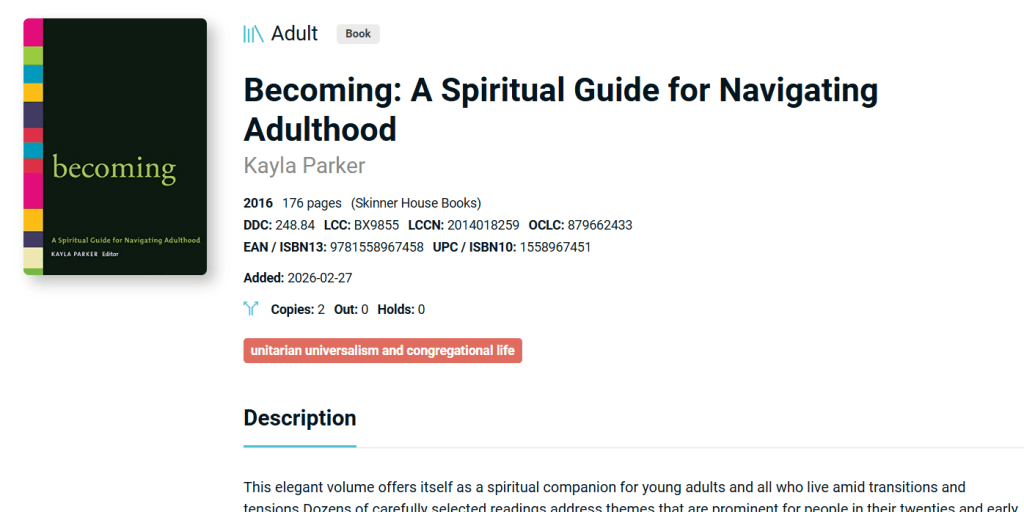
Search the catalog HERE or use the QR code on the bulletin board just inside the library door. Or, you can just browse the old-fashioned way. The resources have now been sorted into general categories. If you find something in the electronic catalog that you want to check out, you can find it on the shelf in the section indicated by the red tag. The example below is a book that can be found in the Unitarian Universalism and Congregational Life section! Please note that tags may only show up in the desktop version of the libib catalog on some devices.

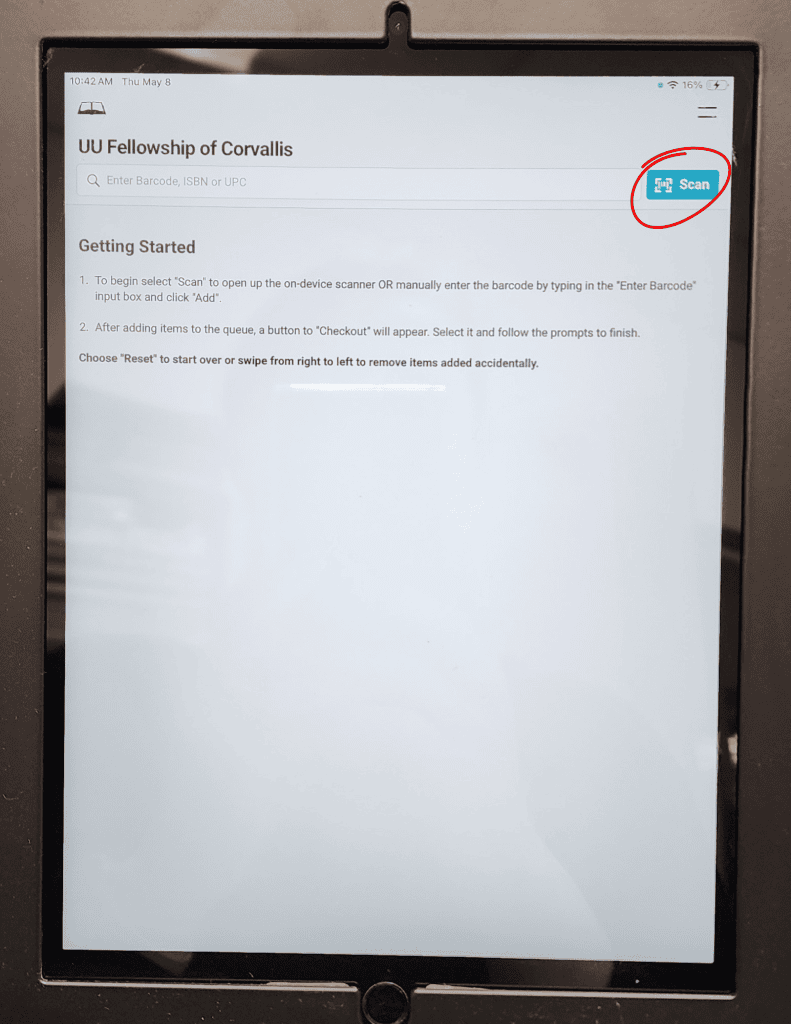
Once you’ve found the book you want to take home, you could sign it out in the check out binder OR you could use your handy dandy new library card at the kiosk! If the iPad has gone to sleep (it probably has), simply press the button at the bottom to wake it up. Then you’ll find the libib kiosk app and tap it to open.

You’ll immediately be at the checkout screen. There are directions on the screen. Let’s walk through them together!

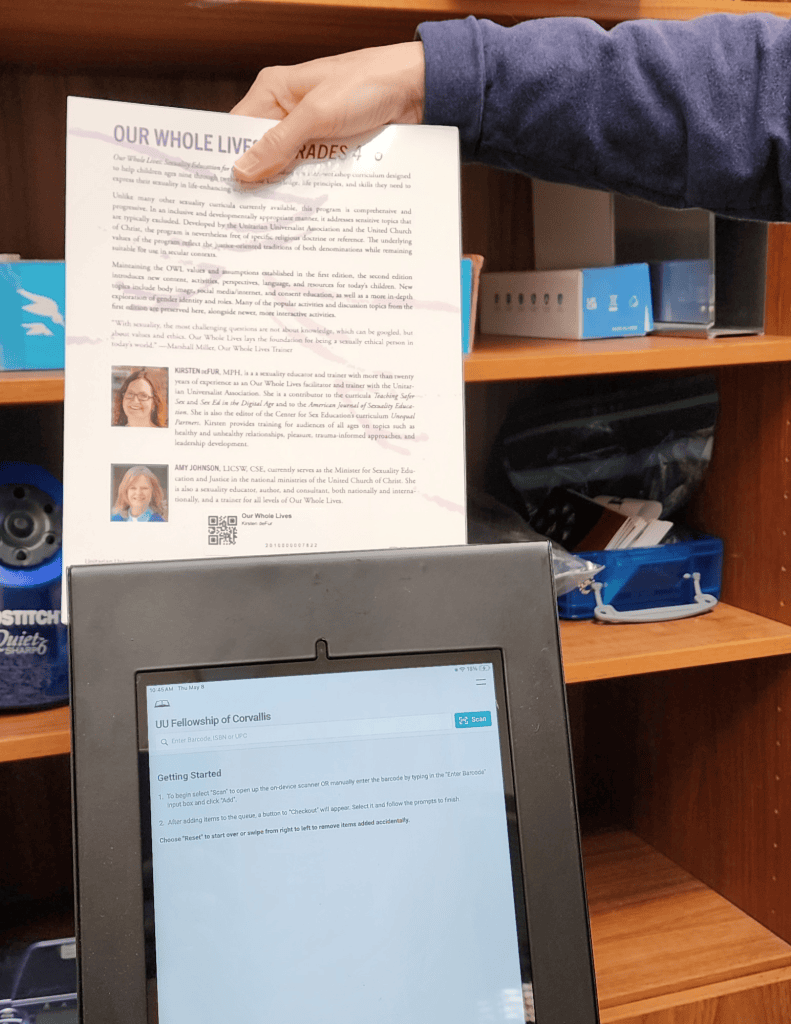
The first thing you’ll do is tap the blue SCAN button. This will open the camera on the back of the iPad to scan the QR code on the back of your book.

Simply lower your book (or movie or card deck) behind the iPad so that the QR code shows up on the screen.

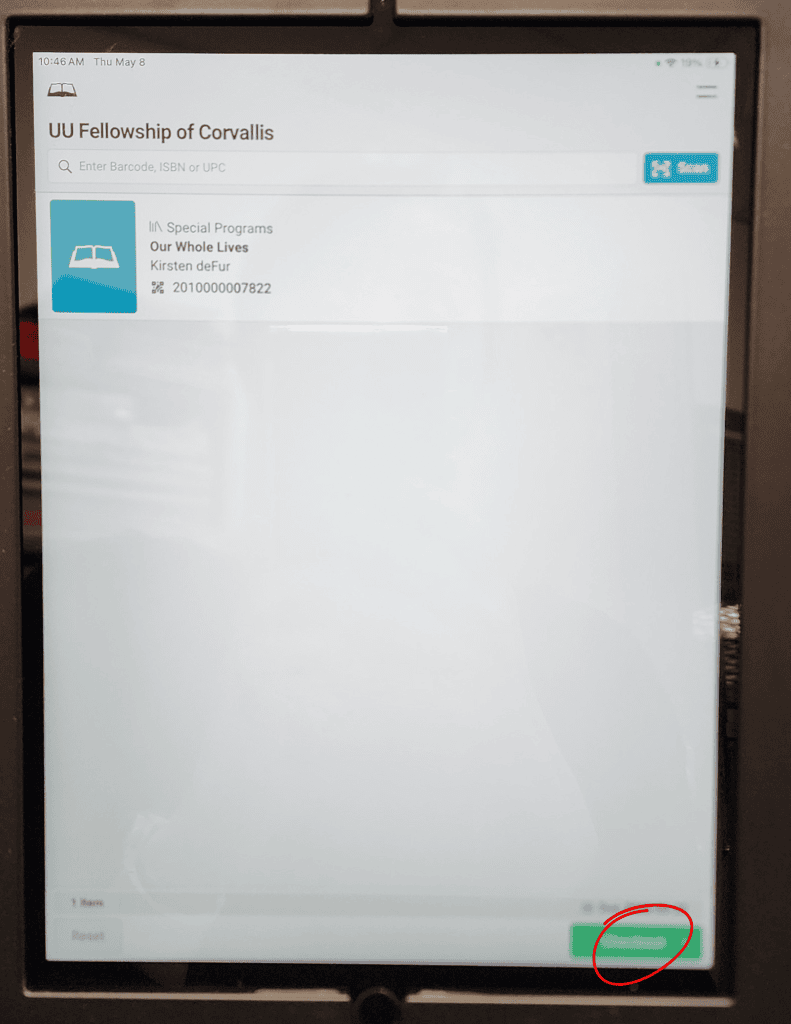
As soon as it scans the code, it will say Success! and then your item will appear listed on the screen. You can scan until your heart is content. I mean, let’s be reasonable, but yeah. Take all the things you plan to read in the next little while.

When you’re all done, you’re ready click the CHECKOUT button in the bottom corner. Sometimes it’s green. Sometimes it’s blue. Life is a mystery!

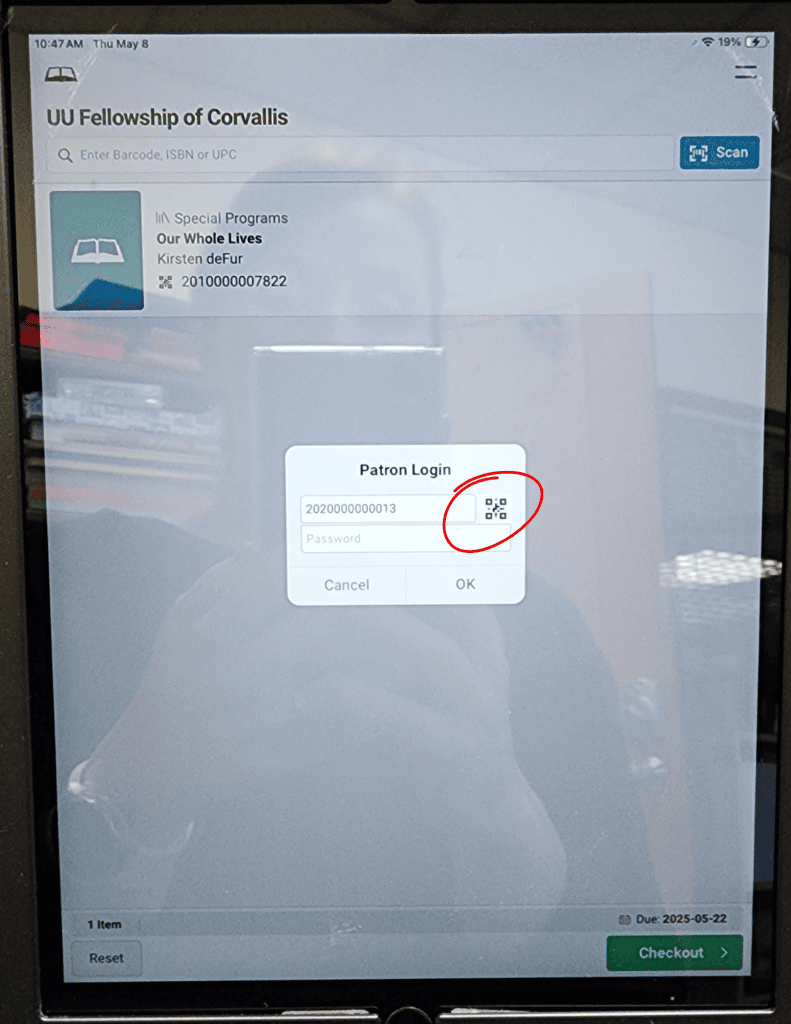
Finally! The moment you’ve waited for! The chance to use your super cool Fellowship Library Card! You could enter your patron ID in manually, but that’s so boring when you could tap the QR code and then just scan your card like you did the book.

As soon as it has registered your patron QR code, you’ll be greeted with another friendly Success! message and you’re ready to go tell your friends how easy and fun that was.

When you’re done with your items, please return them to the “returns” basket located on the shelf to the left of the window. One of your friendly neighborhood library volunteers will check it back in and reshelve it for you!

If you happen to run into snags, come find or email me. Skyla! I’m happy to help you until we find a new librarian. Or, you know, you could use the binder and move on with your day. That said, I’d really appreciate knowing your experience, what’s working and what’s not, as we learn this new system.

In the earliest stages of our rollout, there may still be books that have fallen through the cracks and haven’t been stickered, or they have an old sticker, and the kiosk doesn’t recognize it. All of these details are things we want to know about! Please, if you have the time, don’t just stick the books back on the shelf if you find an anomaly that isn’t in the system correctly. Let me know so I can fix it!

Thanks for being a Fellowship library patron! You rock!

OMG! (Open Minds Group, grades 7-12)

A faith of their own.

OMG! is a place for youth to discover whether and how Unitarian Universalism belongs to them, not simply to their parents. Adolescence brings increasing freedom to decide what they believe, who they want to become, which communities they will belong to, and how they will move through a world their families can no longer fully mediate for them.

Through religious exploration, field studies, community, leadership, serious conversations, ridiculous fun, and increasing responsibility for shaping the group itself, youth practice that independence while they still have a community committed to helping them navigate it. They encounter other religious and philosophical traditions, examine their own beliefs, practice meeting difference with humility, and discover what it means to live their values alongside people who may not share all of them.

Guides co-lead with youth and step back whenever youth are willing and able to step forward. The program provides a safe, covenantal container, but youth increasingly help determine what happens inside it. They’re not just imagining the communities they want to inhabit; they’re practicing how to co-create them with other people.

Our hope is that they eventually bridge from our care into the adult world able to say: I know who I am. I know what I value. I have practiced living it. And I know who I can call when the world makes those things hard to remember.

What Sundays look like

Youth usually begin in the sanctuary and leave together after Time for All Ages. In OMG!, our familiar rhythms of lantern lighting, check-in, covenant, relationship, and exploration continue—but religious studies increasingly take the place of the immersive stories of Seeker Space.About once each month, that exploration moves beyond our walls through Religious Field Studies.Youth also occasionally gather for overnights and events with UU youth from other congregations, creating opportunities to experience Unitarian Universalism as something much larger than the church their family happens to attend.

Religious Field Studies

This year our youth encounter Unitarian Universalism alongside religious and philosophical traditions including Paganism, Hinduism, Judaism, Buddhism, Christianity, Islam, and Humanism. We want them to develop religious literacy and cultural curiosity—but also something deeper.

Understanding other traditions helps youth more clearly understand what it means to be UU: where our tradition shares wisdom and aims with others, where meaningful differences remain, and what they actually believe.

On field studies, we practice being humble pilgrims. Youth prepare questions in advance, enter other communities in a posture of curiosity and learning, and consider how their words and actions might be experienced by the people welcoming us. They represent both our congregation and our faith tradition with respect and care.
We hope this practice helps them enter the wider adult world able to encounter difference with humility, without needing to abandon their own identity in order to honor someone else’s.

Fun is part of the formation

The overnights, games, food, adventures, and sheer silliness aren’t rewards for doing the “real” religious education.They are part of it.Experiencing joy in UU spaces beyond their home congregation helps youth discover that this faith and these values can belong to them in more than one context—even when nobody from their family is there watching their participation.And friendships matter.The people who support a teenager’s becoming now can become the people they call years later when they’re having trouble remembering who they are.

Trust and confidentiality

Young people need relationships with trustworthy adults beyond their immediate families. Our Guides take that trust seriously. Information youth share about their lives is treated with care and confidentiality within the Guide team so that the adults responsible for the group can support them well.

That trust has necessary safety limits. Guides follow our Safe Congregation practices and legal reporting responsibilities when someone’s safety is at risk.

Honoring both confidentiality and those responsibilities is part of how we build relational and institutional trust.

Good to know

Youth who are here are not expected to perform enthusiasm. They may observe, take time to warm up, question what we’re doing, and participate differently from one another. And increasingly, whether they come at all becomes their choice.

That’s part of why we work so hard to make OMG! a place worth choosing.

Helpful links

Register for Childen and Youth for Religious Exploration →

Free Childcare Form →

Inclusion & Accessibility →

Safe Congregation Policies and Practices →

Resources for Families →

Learning Overview

Growing a faith that can grow with you!

Religious Exploration at UUFC is more than a collection of Sunday morning classes. Across the lifespan, we create opportunities to deepen relationships, encounter new ideas and experiences, and develop spiritual practices and capacities that can keep growing and changing with us.

Throughout our lives, we return to four big questions:

What do I inherit?
What stories, traditions, values, and wisdom have been handed to me from my family, culture, and religion?

Who am I?
What do I believe? What matters to me? What does my own inner voice tell me about what is true?

How do I live in right relationship with others?
How do I care for myself and other people, navigate differences, repair harm, and participate in community?

How do I use my power and values to shape the world?
How do my choices help create the communities and world I want to live in? What action are my values asking me to take?

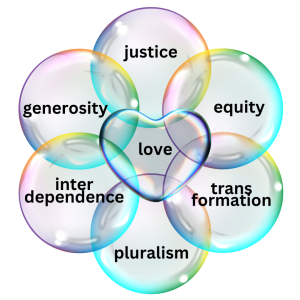
We explore these questions through the lens of our shared JETPIG values, returning to them at different ages, in different circumstances, and with different answers as we grow.

Relationships take time

We want you and yours to have more than a place you recognize on Sunday morning. We want you to have friends you look forward to seeing, a community of care that you can trust, stories and rituals that belong to you and enrich your daily life, and a spiritual home base that makes room for your questions, uncertainty, joy, mistakes, and growth.

Those relationships don’t happen overnight. They are built through repeated encounters.

We invite you to consider what role you hope Religious Exploration will play in your life. There isn’t one right answer. But whatever your hope is, tell us. Talk about it with staff, lay leaders, and friends. Together, we can consider what fulfilling that vision asks of you and of this community.

Come as you are

Families come in countless configurations. Children arrive with different bodies, brains, communication styles, identities, histories, capacities, and needs. Adults do, too. We each bring different needs, abilities, experiences, questions, energy, and ways of engaging.

Participation doesn’t have to look the same for everyone, and participants of all ages are welcome to take the time they need to become comfortable in our spaces.

If there is information that would help us give you or your child a smoother first experience, we’d love to hear from you.

Ready to explore?

Plan Your First Visit →

Inclusion & Accessibility →

Adult Religious Exploration →

Register Children and Youth for RE →

Resources for Families →

Safe Congregation Policies and Practices →

Religious Exploration Council

The role of the Religious Exploration Council is to provide support, guidance, and coordination of RE programs.  The RE Council works closely with the Director of RE  to monitor learning needs across the lifespan of our congregation and develop materials and structures to help address those needs through classes, workshops, events, and volunteer mobilization. 

The primary tasks of the RE Council include:

~Developing and promoting programs that deepen our community’s capacity for spiritual and faithful living;

~Assessing unmet congregational needs for learning and communicating those with staff;

~Identifying potential volunteers and connecting them with the opportunities best suited to their skills and interests.

Seeker Space (grades 4-6)

A practice space for the rest of the world.

Seeker Space is where children get to put the stories and values they’ve inherited to the test. This is an age when kids are increasingly able to notice contradictions, hold competing ideas, spot hypocrisy, and ask whether what they’ve been taught actually makes sense. We think those emerging capacities belong in religious life.

Through immersive adventures, role-playing, stories, games, and plenty of movement, Seekers practice questioning, disagreeing, discerning, collaborating, and figuring out what they believe. Rather than asking children simply to absorb our values, we give them opportunities to try those values out in complicated situations and notice what holds up.

This is also the first age at which our children create a covenant rather than simply working within classroom rules. A covenant is an agreement about how we will be together, and at this age children have increasing agency to participate meaningfully in creating, testing, and keeping those agreements.

The promise underneath it all is important: you can test what you’ve inherited here. You can share what’s hard and ask difficult questions. You can change your mind. None of that puts your belonging at risk

What Sundays look like

Seekers begin in the sanctuary with their families and leave together after Time for All Ages.

In Seeker Space, we light our lantern, check in, revisit our covenant, and then dive into immersive exploration. Role-playing adventures, values dilemmas, active games, and wisdom stories from around the world give children ways to explore big questions without spending Sunday morning sitting around intellectualizing them.

The games are fun on purpose. They’re also doing work underneath the surface: practicing deep listening, noticing context clues, honoring other people’s contributions, negotiating differences, making decisions together, and trying out ways of being in relationship.

Relationships matter here

Peers become especially important at this age. Kids are much more likely to want to spend Sunday morning here when the people they consider their people are here, too.Our Guides are becoming trusted confidants as well as teachers. They listen seriously to children’s needs, ideas, struggles, and hopes and offer warm, loving feedback. They shape the program in response to the group while still providing most of the structure and direction.Regular enough participation for acquaintances to become actual friends—and relationships that sometimes extend beyond Sunday morning—helps make Seeker Space a community children experience as their own.

Participation can look different

Children may opt out of any activity. They can watch. They can sit nearby. They can take their time.We believe engagement requires trust, and trust requires time. We also believe that more learning happens from the sidelines than most adults realize. Proximity to learning is often excellent learning.What children may not do is make participation difficult for everyone else. If a child’s way of opting out becomes disruptive or communicates to other children that their participation is embarrassing or “lame,” we’ll first invite them into a more relational way of being present. If that’s simply not possible for their body that morning—which can be entirely developmentally appropriate!—we’ll lovingly reunite them with their family in the sanctuary. They’re welcome to try again another Sunday.

Good to know

Seeker Space children begin Sunday in the sanctuary with their families and leave together for Room 9, at the top of the classroom wing stairs, after Time for All Ages.

Pick-up is at 11:15 AM, or immediately following the service if it runs long.

Helpful links

Register for Childen and Youth for Religious Exploration →

Free Childcare Form →

Inclusion & Accessibility →

Safe Congregation Policies and Practices →

Resources for Families →