
Behind the Music: How sweet it would be if I found I could fly

This morning we were asked to consider the different meanings of freedom, especially in context with the Fourth of July: political freedom, religious freedom, historical freedom, freedom from fear, freedom to share one’s truth, and inner, spiritual freedom. The piano works that I selected for today’s service all have a connection with freedom, albeit approaching the topic from different angles.

With yesterday’s holiday in mind, I opened with the American folk song Oh Shenandoah. While not directly about freedom, it has such ties to early America, due to its history as a shanty sung by boatmen traveling back and forth across the Missouri River. It’s sheer serendipity that Rev. Alex spoke of Monticello in her sermon, as both the Shenandoah Valley and Monticello share some commonalities. Both are famously “American” locations with connotations of liberty, the former with its frontier settlers and immigrants in search of freedom and land, the latter as the home of Thomas Jefferson, a vocal advocate for liberty and equality. However, the Shenandoah Valley and Monticello hold histories that contradict its associations of freedom; both utilized slavery as a major part of its operations and livelihood. It’s refreshing to see these two locations with ties to freedom and history beginning to demonstrate reform when sharing their stories today; Alex mentioned Monticello’s progress in telling not only Jefferson’s story but the stories of the those enslaved by him, and the National Park Service now includes a spotlight for African American history in the Shenandoah Valley. The simplicity of Oh Shenandoah belies the complex and not always picture-perfect history of its subject, but it’s sense of longing and spacious land, not to mention its tender lyrics have made it a beloved classic. There are numerous renditions of this old tune, but Keith Jarrett’s improvisation upon Shenandoah is one of my favorites.

The second piece in the prelude is more of a deep cut: one of the themes from the 1998 film The Mask of Zorro. While a swashbuckling period film based upon a pulp fiction vigilante doesn’t seem a likely source for music related to freedom, the historical backdrop of Alta California’s rule shifting from Spain to Mexico provides a theme of rebellion against oppressors. The film is good fun – even if one has to suspend their disbelief when watching an elderly Zorro portrayed with an English accent, thanks to Anthony Hopkins – and its music by the late, great James Horner swings between gloriously adventurous to tender and full of longing. The theme (called Diego’s Goodbye in the rendition provided here) recurs throughout the movie in different guises, first sweeping and heroic, next appearing as a delicate lullaby, then as the love theme. The entire score for the film was well-received; the pop version of the the theme underscoring the credits winning multiple awards, and some said that this original soundtrack surpassed Horner’s most lauded film score, Titanic.

Today’s offertory may have only been known to true blue jazz fans: Hymn to Freedom, by the legendary Oscar Peterson. Years ago, David and I were about to celebrate our first wedding anniversary, and learned that Oscar Peterson would be performing at Dimitriou’s Jazz Alley in Seattle. As a young married couple, and as a young married couple of artists – David was in the middle of his doctoral program at the University of Washington, and I was working as a freelance pianist – the tickets for the concert were way out of our price range. But we both loved Oscar Peterson, and since he was already in his eighties, we knew there might not be many opportunities left to see one of the greatest jazz pianists of all time perform live. (Peterson passed away the following year.) So we put our Oscar Peterson tickets on our credit card, and enjoyed the once in a lifetime opportunity to hear this jazz legend perform. Hymn to Freedom became one of Peterson’s signature works, and its jazzy yet prayerful feel plus its lyrics by Harriette Hamilton made it one of the anthems of the Civil Right’s Movement.

That’s when we’ll be free

When every heart joins every heart
And together yearns for liberty
That’s when we’ll be free

When every hand joins every hand
And together molds our destiny
That’s when we’ll be free

Any hour (Any hour), any day (Any day)
The time soon will come
When men will live in dignity
That’s when we’ll be free

When every hand joins every hand
And together molds our destiny
That’s when we’ll be free

Any hour (Any hour), any day (Any day)
The time soon will come
When men will live in dignity
That’s when we’ll be free

When every man joins in our song
And together sing in harmony
That’s when we’ll be free

Any hour (Any hour), any day (Any day)
You know the time soon will come
When all men will live in dignity
And that’s when we’ll be free

Closing with another Civil Rights Movement anthem, I Wish I Knew How It Would Feel to Be Free, felt like the perfect way to end the service. The song’s text makes it clear that freedom hasn’t been obtained yet, but the music itself is upbeat, confident, refusing to give in to despair. Written by Billy Porter for his daughter, the song quickly took off and represented the fight for equality and justice for many. Covered by countless artists, the definitive performance is by Nina Simone, who sang the song countless times: sometimes slower, sometimes with more of a gospel feel, but always with hope and determination that equality and freedom would be possible one day.

Behind The Music, 6/28/2026

Here is a little background on the music that was played this morning at the service.

Prelude: Coming Home, by Carolyn McDade

If you don’t know Carolyn McDade by name, you probably know some of her songs. Three that we do often at UUFC are Come Sing a Song With Me, We’ll Build a Land, and Spirit of Life.

A few weeks ago a book of songs by Carolyn McDade appeared in the music office. It sat there for a few weeks until I finally found some time to play through the songs. I found one called Coming Home which had a tuneful melody and nice chords. Jumping ahead to this morning, I was still trying to decide what to play for a prelude, and I remembered this song. 

If you know the song, you may not have recognized it. Or you might have only recognized little snippets of it. Before I started at UUFC I worked with another music director who always encouraged me to improvise. He had an interesting strategy that worked surprisingly well: play a version of a song in such a way that people barely recognize what it is. The idea is to use the song as a jumping off point, but to make yourself invent variations on the chords, melody, and rhythm. I do this often for the prelude – sometimes with songs we’re singing on that service, and other times like today I pick other songs.

I wish I could find a publicly available recording for you, but I haven’t been able to find one. Here are the lyrics of the chorus:

We’re coming home to the spirit in our soul, 

We’re coming home where the healing makes us whole, 

Like rivers running to the sea,

We’re coming home,

We’re coming home.

Offertory: Aria from the Goldberg Variations by J.S. Bach

There is a well-known story about this piece that may or may not be true, but I’ll tell you anyway. The story goes that Bach wrote it at the request of Count Kaiserling, an insomniac who  asked Bach for a set of variations to help cheer him up when he couldn’t sleep. Goldberg was the name of the harpsichordist who lived with the count and was probably the first performer of the Goldberg variations. 

I chose it because I wanted to play something that represented part of the musical ancestry of so many of the songs we sing on Sunday mornings. If you ever look at the index of composers in the back of the hymnal, you’ll see quite a few songs are either composed or harmonized by J.S. Bach, and there are many more that are emulating the choral style for which Bach is well-known. For what it’s worth, that includes pretty much any of our hymns that sound like they should be played on the organ.

It’s a theme with variations, but I only played the theme this morning. I highly recommend listening to the entire piece in one sitting someday. Although it was written for the harpsichord, one of the most famous recordings of the Goldberg Variations is done by a pianist named Glenn Gould. Here is a video where you can watch him play it. He is known for his quirky mannerisms and humming along to the music, which makes it kind of fun to watch as well as listen to:

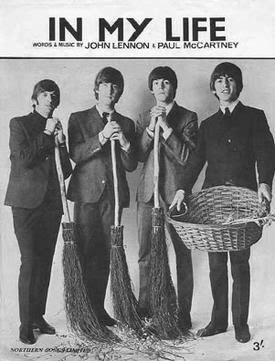
Postlude: In My Life, by John Lennon and Paul McCartney

I played “In My Life” by the Beatles for a few reasons: first because the lyrics talk about the past and how some things change, and others stay the same, and all have an impact on today, so I thought it had some connection to today’s theme about history and learning from the past. Second, because it contains a short Baroque-sounding solo in the middle of the song, so I thought it might tie in nicely with the Bach piece I played for the offertory. 

After the service Carl, our current board president told me an interesting story about that solo. I was practicing it this morning and realized that it was kind of tricky to play, and I was having some trouble with it. Apparently George Martin, the person who played it on the album, had trouble with it too. Carl told me that the solo was actually recorded at half speed and sped up for the album, which made me feel better. 

I found this recording of the solo the way it was recorded at half speed, and then the original recording where the solo is sped up:

I hope you found it interesting to hear about the music. Usually a handful of people come up to me after a service and ask me about things I played, so I wrote this in case there are others who are also curious but didn’t come up and ask.

David Servias

Behind the Music: Peace and quiet and open air, wait for us, somewhere

Photo by David Brooke Martin on Unsplash

It is fitting that Pride and Juneteenth both occupy the same month, as both focus on being free, being seen, and being ourselves.  The human race has made significant strides toward liberty and inclusion, but “othering” still rears its ugly head at times, and there is more work to be done.  Countless works of music would have been appropriate for today’s service, and it was challenging – but fun! – trying to select today’s music.

The prelude opened with George Shearing’s jazzy, modern arrangement of Somewhere Over the Rainbow, the beloved ballad composed by Harold Arlen for The Wizard of Oz.  Full of wistfulness and longing, this song about wishing for a place “where troubles melt like lemon drops” has spoken to generations of people with dreams of a world without fear and exclusion.  The famous melodic leap from “Some” to “where” demonstrates some subtle text painting; the octave ascends as if reaching and searching for this new idyllic place. Renowned jazz pianist and composer Sir George Shearing reframed the familiar melody with new harmonies and dissonances that add complexity to the song, while retaining the hope of the original. Shearing played his version of this song as an upbeat tune when playing with his jazz trio, but the work is arranged so well that it is often played as a piano solo with a slower, reflective air, as performed today.

True Colors was originally created with a much different vision in mind. Composer Billy Steinberg (who also penned several other commercial hits from the 80s and 90s) originally wrote this as a gospel song in honor of his mother, trying to express the concept of a parent’s unconditional love for their child. His songwriting partner Tom Kelly thought that the idea of someone loving you exactly as you are was beautiful, and could be applied to all kinds of relationships, not just mother and child; so the two modified the song to express any and all unconditional love. Cyndi Lauper wanted to sing the song, and when Steinberg and Kelly listened to her recording, they were surprised and enamored by the lean, stark character of her rendition – a far cry from the song’s original gospel style. Its message is simple but powerful: our truest selves are not something to hide, apologize for, or diminish, and if we let our true colors shine through, there will be people who find them beautiful and worthy of love.

There are so many wonderful pieces of music about love, acceptance, equality, inclusion, pride, and Pride, and it was hard to narrow down which pieces I would select for today’s service. But I think I always knew that I would play Somewhere from the seminal West Side Story, by Leonard Bernstein and Stephen Sondheim. This song marks a pivotal point in the musical: Tony has accidentally killed Maria’s brother Bernardo, and the chance of any sort of happy ending for the lovers seems all but destroyed. They cling to the fragile hope that a life without prejudice, violence, and fear can still be possible “somewhere”. But the song isn’t just remarkable for its dramatic power; the composition is a marvel of melodic, harmonic, and text writing, frequently held up by performers, scholars, and composers as an example of a perfectly crafted song. The melody is full of reaching, grasping intervals, including the seldom used melodic minor seventh, leaning into the interval’s natural uncertainty. The unexpected harmonic progressions keep the song suspended between stability and uncertainty, and the phrases resolve a little differently than you expect them to, mirroring Tony and Maria’s emotions: frightened and unsure, but with moments of hope and tenderness. And the text…Sondheim’s lyrics in his own works are wickedly clever, very cerebral and extremely funny. But in Somewhere, he refrained from gilding the lily and the simplicity of his words transform this song into a prayer as simple as the things that Tony and Maria long for. They have no desire for riches or grandeur, glory or material possessions; they dream of the simple things that we would all have in an ideal world: safety, love, acceptance, and peace.

Today’s postlude was I’m Coming Out, made famous by the incomparable Diana Ross. It is jubilant, demands attention, and is gloriously declarative. This song has been claimed long ago as a Pride anthem of visibility and self-acceptance. And through the lens of Juneteenth, it can also be heard as a celebration of liberation – freedom from oppression, and the freedom to experience joy, dignity, identity, and a rightful presence in the world. There is no shortage of joy in this song, and its energy felt like an appropriate way to end the morning. May we all know the freedom of coming out into the world as our true selves, and with pride in who we are.

BONUS ITEM #1 – BEHIND THE SCENES: Today’s music for reflection was going to be an outline – but not a full realization – of John Lennon’s Imagine, using the harmonic progression paired with fragments of the melody. However, due to a series of ridiculous events, this did not happen! Shortly after the service started, one of my contact lenses started shifting around; I suspect the small fan I had blowing on my face might have sent a speck of dust into my eye. Reduced to seeing with only one eye, I reached into my bag to grab my glasses, and then realized that they must have fallen out when I knocked my bag over last night. I slipped out to get the glasses I keep in my car, then came back in trying to be as quietly as possible. In my efforts to be inconspicuous, I squeezed my keys to keep them from jangling, but ended up squeezing the Tile tracker on my keys…which sets off a ringer on my phone even if it is silenced, so that I can locate it if lost. I spent the time that I would have pulled up Imagine on my iPad leaping into action to silence my phone instead, and then needed to start playing immediately, to avoid any dead space…as a result, I just improvised some delicate chord progressions, all while wishing I could start the day over! 🤣

BONUS ITEM #2 – O LOVE, by Elaine Hagenberg: If today’s choral anthem sounded familiar, revisit this blog post to find out how you already knew this song…

Behind the Music: Don’t look behind you, fly till you find your way towards tomorrow

I have such a great view from the piano bench on Sunday mornings. I get to see faces I have come to know in different ways as they experience what they are seeing, hearing, and feeling before them. (Please don’t feel self-conscious…if it helps, David and I are up in front of you all the time!) Today I saw pride, nostalgia, amusement, tenderness, and joy. Some folks were celebrating their own children at the front of the room, while others may have been remembering rites of passage from their own history. There was laughter when our youth let their personalities and candor shine through their prepared words, and camaraderie and support as we watched a friend take a symbolic step forward. The whole service was not only a beautiful way to recognize transitions but a reminder that “growing up” isn’t just for children, and today’s piano selections reflected how we are always growing into new versions of ourselves as we learn and change.

Joni Mitchell’s The Circle Game is such a wonderful song about the passage of time, using the metaphor of a carousel to paint the cycle of seasons we move through in our lives. This familiar imagery represents how quickly life moves as well as how it’s not always easy to notice change as we are living through it, since we are focused on what is presently happening the ride rather than the journey. Joni Mitchell gives the definitive performances of her song, but since readers likely already know her renditions of The Circle Game, I offer here a performance by the inspiring PS22 Chorus. While they have performed with renowned artists and reputable events/venues (including the White House, the Oscars, and on Sesame Street), it’s this choir’s unpretentious background as a music class at a public elementary school that will make you fall in love with their earnestness, sweet young voices, and love of music.

Dos Oruguitas (“Two Little Caterpillars”) accompanies the story of Abuela Alma Madrigal and her husband, Pedro, in the Disney film Encanto. Using the imagery of two caterpillars who must let go of one another in order to become butterflies, the song is about love, separation, transformation, and pain. The story asks us to recognize that growth can require courage, and is sometimes the result of grief and loss. But it also reminds us that love does not disappear when life changes; it comes into our lives in different forms. We love as children, as siblings, as partners, as parents, as elders, as friends, and as members of a community…and each new form of love asks us to grow.

“How Far I’ll Go,” from Disney’s Moana, comes from a very different kind of story, but also speaks powerfully to growth. The teenage Moana loves her home and her people, yet feels drawn toward the ocean and toward a calling she does not completely understand. The song gives musical form to the moments when we recognize that there is more than just our familiar world, when something inside us begins asking where we are meant to go, and when wonder what we are meant to learn and who we are meant to become. That question belongs to children and teens, but it also belongs to adults. There are many moments in life when we find ourselves like Moana, standing at the edge of what we know, wondering what lies beyond the horizon.

(It is worth noting that the music from Encanto and Moana are by the extraordinary Lin-Manuel Miranda, who also penned the Tony and Pulitzer-awarded Hamilton. Both movies are stunning – visually and musically, and in their deeply moving stories – and if you are not familiar with either one, these beautiful, beautiful films about heritage, family, and culture are worth checking out, whether you are very young, very old, or somewhere in-between.)

Behind the Music: Sing out loud

Music plays many roles in our lives, but the one emphasized in today’s service is that music has always been one of the ways people carry home with them. We may leave places behind – whether by choice, necessity, or force – but the songs we sang in the various homes of our lives remain. Music can remind us where we came from, with memories, language, faith, and atmosphere.

The piano music for this service brings together two ideas: song as a source of expression and community, and music as a vessel for heritage, memory, displacement, and belonging.

The prelude began with a gentle cover of Woody Guthrie’s This Land Is Your Land, with occasional new harmonies that help us hear the song a little differently.  Instead of the rousing version we are used to, it becomes more reflective.  Are we living as if this land belongs to everyone?  Who has been welcomed, and who has been left out?  If imagined through through the lens of immigration and refuge, the song becomes a statement of a shared home, but also a dream that we fervently wish will be true someday: that “home” might be generous enough to include all who seek safety, dignity, and a place to belong.

Following This Land is Your Land, I played Paul Simon’s American Tune, a song based on Johann Sebastian Bach’s hymn O Haupt voll Blut und Wunden (“O Sacred Head Now Wounded”). It is weary and searching as it refers to uncertainty and struggle when in the United States, far from home.  While not particularly uplifting view of life in America, it offers a glimpse of hope in its final phrase.

Many’s the time I’ve been mistaken
And many times confused
Yes, and I’ve often felt forsaken
And certainly misused
Oh, but I’m all right, I’m all right
I’m just weary to my bones
Still, you don’t expect to be bright and bon vivant
So far away from home

I don’t know a soul who’s not been battered
I don’t have a friend who feels at ease
I don’t know a dream that’s not been shattered
Or driven to its knees
Oh, but it’s all right, it’s all right
For we’ve lived so well so long
Still, when I think of the road we’re traveling on
I wonder what’s gone wrong
I can’t help it, I wonder what’s gone wrong

And I dreamed I was dying
I dreamed that my soul rose unexpectedly
And looking back down at me, smiled reassuringly
And I dreamed I was flying
And high up above, my eyes could clearly see
The Statue of Liberty sailing away to sea
And I dreamed I was flying

For we come on the ship they call the Mayflower
We come on the ship that sailed the moon
We come in the age’s most uncertain hour
And sing an American tune
Oh, and it’s all right, it’s all right, all right
You can’t be forever blessed
Still, tomorrow’s going to be another working day
And I’m trying to get some rest
That’s all I’m trying to get some rest

Many are familiar with Joe Raposo’s Sing from the Carpenters’ rendition, but not everyone knows that this beloved song was originally created for Sesame Street.  Raposo was a renowned composer employed by Jim Hensen who also penned the Sesame Street theme and songs “C is for Cookie” and “It’s Not Easy Bein’ Green”.  He was also the child of Portuguese immigrants, a fact which gives new depth to this beautiful children’s song.  Singing is one of the oldest ways to preserve identity, pass on memory, and join a new community without erasing where one came from, and singing with others does a great deal to help us find a sense of belonging.

The postlude, Make Your Own Kind of Music, was made famous by Cass Elliot (a.k.a. Mama Cass, Elliot’s less preferred nickname).  All four of Elliot’s grandparents were Russian-Jewish immigrants. This top forty hit’s message – to keep singing your own song even if others do not immediately understand it – aligns strongly with experiences of displacement and belonging.  Immigrants, refugees, and their descendants often live between cultures as they treasure inherited stories, accents, customs, music, and memories while trying to make a home in a new place. The lesson from this song applies to both music and the world in general: one’s unique voice is not only not something that should be hidden in order to belong but is something that helps enrich the larger community.

Join the Choir, Wednesdays at 7 PM

Embroider your life with song! The UUFC Choir meets every Wednesday at 7:00 PM in the Sanctuary and is open to anyone – whether you have musical experience or not. There is no audition.

We sing a variety of pieces – each with unique style, instrumentation, and cultural significance – which allows for diverse musical exploration and personal expression.

The Choir is a great way to be of service to our Fellowship community… and have FUN! Contact Director Steven Evans-Renteria for more information at this link.

Childcare is available!

Free childcare can usually be arranged for any Fellowship event by using this link 1-2 weeks prior to the event.

Behind the Music: I’ve looked at clouds from both sides now

Growth and perspective are beautiful parts of any life – and of any community. Today’s piano selections all hold meaning that fit into this Sunday’s theme of spring cleaning and transformation. Growth sometimes asks us to let things go but it also invites us to look more closely at what can be deepened, reshaped, or carried forward.

Today’s service started with a solo piano version of Come Thou Fount of Every Blessing as the prelude. While this classic hymn might have been familiar to anyone who has ever attended a Christian church, I wanted the melody to be in the ears and minds of those for whom it was new. Renowned church composer and arranger Joseph Martin created an ethereal arrangement that turns the musically square tune – referring to its very vertical sense of rhythm, like a slow march – into something flowing and flexible, letting us hear the song immediately before singing without getting tired of it. This hymn was composed in 1758, by Robert Robinson, whose teenage years were spent engaging in frivolities and debauchery. However, upon hearing a sermon on divine grace from preacher/orator George Whitefield (one of the fathers of the Methodist church), Robertson converted and became a pastor himself by the age of twenty-two. The original lyrics were explicitly Christian, but when creating a new Unitarian Universalist hymnal (which we now know as Singing the Living Tradition), the strong bones of this hymn were recognized, and once portions of the original lyrics were rewritten, a beautiful hybrid of traditional and new became part of the UU repertoire.

Turn! Turn! Turn! may be the only example I can think of of an unaltered Bible verse that’s been adapted into a wildly popular hit pop song. The Byrds’ performance of Pete Seeger’s composition became a chart topper in the middle of the Vietnam War and the formation of the 1960’s counterculture. Whether interpreted as a protest song or voicing the idea that change happens, it’s a catchy reminder that transformation unfolds within a larger rhythm. The form and layout of the music mirror the song’s meaning: the repetition of “To everything, turn, turn, turn…” creates a cyclical pattern, echoing the changing of seasons.

Turn! Turn! Turn! was originally meant to be an accompanied vocal solo today, but due to a cold – or perhaps the Willamette Valley’s allergy triggers! – it became a solo piano reflection instead. David Lanz’s rendition (performed here by the arranger) is a particularly lovely way to experience this old favorite.

Both Sides Now is universally loved for so many reasons: its poignant melody and harmonies, its poetic lyrics, and its themes of vulnerability, uncertainty, and perspective. What once seemed simple becomes more complicated upon closer inspection. Our views and beliefs evolve the more we learn. Earlier experiences are not erased, but broadened with greater understanding. When placed in the context of Rev. Alex’s sermon, it begs the questions “When is it time to let something go? And what are we holding on to – and why does it matter?”

The arrangement of Both Sides Now that I played today is from the 2021 film CODA [the acronym for Children of Deaf Adults – swept industry awards a few years ago with its moving portrayal of a gifted singer born to deaf parents. Any and all times that Joni Mitchell has sung Both Sides Now will always be the gold standard against which all other performances are measured against…but I challenge you to not tear up when watching this video of Emilia Jones singing and signing Both Sides Now for her deaf family during her conservatory audition. They can’t hear her gorgeous voice, but they can appreciate the deep meaning behind the words she sings, and understand the weight they carry as her character grows up.

I had a different postlude planned for today, but after the Time for All Ages included the messages that today was Palm Sunday and that being Unitarian Universalist and Christian (or any other religion) need not be mutually exclusive, I had two immediate thoughts. The first was that I would have to play “Hosanna” from Jesus Christ Superstar for the postlude, which was immediately followed by my asking myself question “the UUFC community will know this song…right?” Sometimes I play selections pulled from the musical theatre world that aren’t as well known, but I made a little bet with myself that if I played “Hosanna” today, it would be recognized. I was delighted to see a number of congregants gathered by the piano who not only were familiar with the song but who were joyfully singing along!

Behind the Music: How Deep is Your Love?

Romance and partnerships are what immediately come to mind when hearing “love” in February, but this compact little word is so much more complex and holds a multitude of meanings. You can love your significant other, your family of origin, your family of creation, your chosen family, your friends, and your dog. You can also love your neighborhood, your community, and those you teach or help. And, you can feel love for a little boy in a blue bunny hat who you’ve only seen on television, or for two strangers who are grieving the murder of their child, a healer whose last words to were to ask if someone was okay. Love can be romantic, platonic, hopeful or painful; it can be joyfully exuberant, or quietly steadfast. Today’s piano selections offered a glimpse of some of the ways love can appear in our lives: a promise, ardor, care, compassion, the sacred, healing, and affirming.

https://youtu.be/0put0_a–Ng?

Make You Feel My Love is surprisingly simple in its presentation. There is no flowery language, dramatic imagery, or big musical/emotional climax; instead, the song is a quiet vow of steady, enduring love. Bob Dylan wrote this contemporary standard, but rather than hoarding the recording rights, he shared advance copies of the music with other artists, and the world was first introduced to Make You Feel My Love by Billy Joel. Bob Dylan eventually released his own performance, and as the song became a hit, countless other musicians covered this song, drawn to its tenderness and statement of unconditional love.

https://youtu.be/1XCUX4mkE4g?

To Love You More sharply contrasts Dylan’s song about peaceful and plainspoken love with its sweeping, romantic intensity. Originally written as the theme song for a Japanese TV drama, it skyrocketed to the top of the charts around the world and is now one of the signature power ballads that Celine Dion is known for. With its theatrical dynamics, virtuosic vocal writing, and impassioned lyrics, To Love You More is a declamation of passion being shouted from the rooftops. Its energy and momentum are perpetual, and the fervor of both the text and music propel the song to its end, never relaxing.

https://youtu.be/eG9iMJIT5sQ?

Burt Bacharach’s What the World Needs Now Is Love asks us to think of love as a necessity; not just a personal emotion but a universally shared good that the world cannot function without. Its easy-going melody, conversational feel and repetition throughout the song send the message home that yes, “what the world needs now is love, sweet love. No, not just for some but for everyone.”

https://youtu.be/nf49xwqSU0s?

Elaine Hagenberg’s stunning O Love is probably the least known of all the music offered today but in the choral world it is considered a contemporary masterpiece and has been sung by choirs around the world. Its reverent text and luminous setting invite reflection and even played as a piano solo without lyrics, the harmonic dissonances and their resolutions evoke sighs that always transform into hope. The lyrics are based upon text by 19th-century Scottish minister George Matheson. Matheson’s words were originally sacred in nature, but can hold meaning for anyone whose heartache has been healed by love.

O Love that will not let me go,
I rest my weary soul in thee;
I give thee back the life I owe,
That in thy ocean depths its flow may richer, fuller be.

O Joy that seeks me through pain,
I cannot close my heart to thee;
I trace the rainbow through the rain,
And feel the promise is not vain
That morn shall tearless be.

https://youtu.be/XpqqjU7u5Yc?

The smooth groove of the Bee Gees’ How Deep Is Your Love reframes the age-old query: I love you…do you love me? This question really is many questions wrap into one, as it is also asking: Do I matter to you as much as you matter to me? Can I trust you? Am I safe with you? Will you leave me? Does my happiness – or sorrow – mean anything to you? Feeling loved isn’t just something that gives people a warm fuzzy feeling; it provides security, strength, and hope. Feeling loved is more important than ever in the world we live in today. In addition to make sure that the people we care about know that we love them, performing acts of love – to those in our lives, to strangers, to whole communities – is a way to deal with our frustration, our fear, our insecurity. We may not be able to solve homelessness, erase racism, or provide justice for all who have been wronged…but any difference we can make, no matter how small, is putting love into action. Whether in personal relationships, in community, or in the pursuit of social justice, let’s answer the question “How deep is your love?” with both words and deeds.

Behind the Music: A home where we can breathe, to sleep and dream without fear

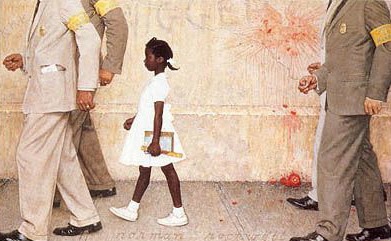
The Problem We All Live With, Norman Rockwell (1964)

Today’s MLK Jr. service reflects on how the spiritual autobiography of our nation will be written, emphasizing how we listen, how we care for the next generation, how we respond to organized and normalized evil, and the importance of being open so we may serve a greater good. The piano selections for today’s service reflect these themes, naming pain, modeling courage, and inviting both reflection and action.

I began the prelude with a piano rendition of B.E. Boykin’s Stardust. While the music alone is gripping and powerful, it is the text and intention behind the music that is the most meaningful. In Stardust, the singers call for the following:

Marcus J. Jauregui – conductor of the Pershing Middle School Treble Chorale Houston ISD and who commissioned this work – shared “When we sing, we pray twice [once with our voices, and again with our hearts], and it is my prayer that this piece stirs all who hear it to call for justice for people of color taken from this world before their time and without concern for their humanity.”

https://youtu.be/i9HMpb4fcbw?si=nO4QeEojWQ9v6Aag

The prelude ended with the theme from To Kill a Mockingbird, a bittersweet piece that I’ve always felt conveys curiosity, lost innocence, and hope despite the ugliness in the world. The story of one good man, Atticus Finch, standing against the entrenched racism in his community, is so special to many of us, and is one of the rare instances of the film measuring up to the original book, as Gregory Peck and Mary Badham’s portrayal of the Atticus and Scout Finch pull at the heartstrings and are hard to forget. Though surrounded by fear and prejudice, Finch listens, teaches, and acts according to conscience, modeling moral courage in the face of hatred and injustice. This theme underscores the responsibility adults bear to model courage, empathy, and justice for those who come after us. By opening ourselves to see the world clearly and to respond to wrong, we honor those who have suffered and provide guidance for the next generation, showing how openness and moral action are inseparable.

https://youtu.be/v04pqVoH7rE?si=VH7UQXv8u0RDByRr&t=3

Blowin’ in the Wind is a song that represents the sixties but has also been described as an anthem of the civil rights movement. R&B singer and civil rights activist Mavis Staples recalled in Martin Scorsese’s documentary No Direction Home that she was couldn’t believe how a young white man could capture the frustration and aspirations of Black people so powerfully. Soul singer and songwriter Sam Cooke was similarly impressed, making it a regular part of his repertoire soon after its release, and also shared that it inspired him to write his own civil rights anthem, A Change Is Gonna Come. The song asks us to listen deeply, be open to what we are asked to hear, and take responsibility to serve a greater good by refusing to ignore racism, honoring both the movement and the individuals whose lives have been affected by racial violence.

https://youtu.be/PBDdLgBO0Nw?si=1kwQ0nLNlvU2l3b5

While Precious Lord, Take My Hand is included in the UU hymnal Singing the Living Tradition, it hasn’t been sung in Sunday services often. However, this felt like the perfect postlude for today’s service, as it was Martin Luther King Jr.’s favorite hymn. Its topics of exhaustion, grief, and fear – but also of courage! – was both comforting and inspiring for MLK, and he often asked Mahalia Jackson to sing the hymn at civil rights rallies. After his assassination, Jackson sang the song at his funeral, and in turn, Aretha Franklin sang it at Jackson’s own funeral. Originally composed after the death’s of composer Thomas Doersey’s* family, the song is a reflection on faith tested under pressure, reminding us that confronting entrenched inequality and hatred is difficult and wearying…but that we can still work toward a greater good and try to sustain justice, mercy, and care in the world. And because this was our postlude and meant to send folks off into the world, starting a new week, I made sure to play a more upbeat, blues-inspired arrangement of the song, because members of the UUFC love to dance their way out of the service!

https://youtu.be/Z0a8RNdnhNo?si=GIqxp9CCHmDyNtRL

*Not to be confused with bandleader Tommy Dorsey

Behind the Music: We’ll Build a Land

Leadership often begins with a call and not a plan; we feel a nudge – or push! – inside of us to step forward. The stories from our Council Chairs provided much food for thought on what fuels our own willingness to contribute and get involved in this community. Today’s piano music all led back to what it means to say yes and pitch in, as we each considered how we are being called to participate.

https://youtu.be/eAR_Ff5A8Rk

There was a touch of the traditional Scottish song Auld Lang Syne to acknowledge the new year, but the heart of this morning’s prelude was Carole King’s You’ve Got a Friend. The lyrics (“When you’re down and troubled, and you need a helping hand…you just call out my name”) remind us of the power of showing up for others and offering steady support. In the same spirit, contributing time, lending a hand, and joining a committee are ways to be a friend to the Fellowship, helping where it’s needed so the community can thrive.

https://youtu.be/nniKY1cTEyY

I played We’ll Build a Land (121 in Singing the Living Tradition) for the offertory…I originally had a different song in mind, but as I listened to Nick, Carl, Scott, and Kathy speak, We’ll Build a Land kept popping in my head instead. This hymn’s message of hope and justice created by shared effort, and its dream of how together we can “build a land where all can dwell in peace” and “make a world of love and truth” were all reflected in the stories we heard. The care, support, and participation from today’s speakers and from every volunteer and congregational leader help shape this “land”, the Fellowship.

https://youtu.be/lXgkuM2NhYI

The decision to use Heroes by David Bowie for today’s postlude may have been influenced by its inclusion in the finale of Netflix’s sci-fi/coming-of-age series Stranger Things, but that doesn’t make it any less meaningful when it comes to the theme of the day. Heroism doesn’t always have to be grandiose or on a large scale – heroes can be people who step forward and give their time, energy, and passion. Even if it simply appears to be everyday participation in congregational life, volunteering, trying something new, and being an active member of this church makes for a better, richer Fellowship for us all.